Israel
Country
Member state of the United Nations.[1]
Parts of Israel
Loading 6 places.
Through time
2,114,020 in 1960, 10,122,800 in 2025
Show as a table
| Year | Population |
|---|---|
| 1960 | 2,114,020 |
| 1961 | 2,185,000 |
| 1962 | 2,293,000 |
| 1963 | 2,379,000 |
| 1964 | 2,475,000 |
| 1965 | 2,563,000 |
| 1966 | 2,629,000 |
| 1967 | 2,745,000 |
| 1968 | 2,803,000 |
| 1969 | 2,877,000 |
| 1970 | 2,974,000 |
| 1971 | 3,069,000 |
| 1972 | 3,148,000 |
| 1973 | 3,278,000 |
| 1974 | 3,377,000 |
| 1975 | 3,455,000 |
| 1976 | 3,533,000 |
| 1977 | 3,613,000 |
| 1978 | 3,690,000 |
| 1979 | 3,786,000 |
| 1980 | 3,878,000 |
| 1981 | 3,956,000 |
| 1982 | 4,031,000 |
| 1983 | 4,105,000 |
| 1984 | 4,159,000 |
| 1985 | 4,233,000 |
| 1986 | 4,299,000 |
| 1987 | 4,369,000 |
| 1988 | 4,442,000 |
| 1989 | 4,518,000 |
| 1990 | 4,660,000 |
| 1991 | 4,949,000 |
| 1992 | 5,123,000 |
| 1993 | 5,261,000 |
| 1994 | 5,399,000 |
| 1995 | 5,545,000 |
| 1996 | 5,692,000 |
| 1997 | 5,836,000 |
| 1998 | 5,971,000 |
| 1999 | 6,125,000 |
| 2000 | 6,289,000 |
| 2001 | 6,439,000 |
| 2002 | 6,570,000 |
| 2003 | 6,689,700 |
| 2004 | 6,809,000 |
| 2005 | 6,930,100 |
| 2006 | 7,053,700 |
| 2007 | 7,180,100 |
| 2008 | 7,308,800 |
| 2009 | 7,485,600 |
| 2010 | 7,623,600 |
| 2011 | 7,765,800 |
| 2012 | 7,910,500 |
| 2013 | 8,059,500 |
| 2014 | 8,215,700 |
| 2015 | 8,380,100 |
| 2016 | 8,546,000 |
| 2017 | 8,713,300 |
| 2018 | 8,882,800 |
| 2019 | 9,054,000 |
| 2020 | 9,215,100 |
| 2021 | 9,371,400 |
| 2022 | 9,557,500 |
| 2023 | 9,849,000 |
| 2024 | 10,002,200 |
| 2025 | 10,122,800 |
Learn more
- Simple English Wikipedia easier reading
- Wikipedia
- Wikidata the structured data behind many facts here
Codes
Changes to this page's data
No changes recorded since the dataset of 5 November 2026.
Sources
- United Nations: Member States Published directly by the source.
- Wikidata: Israel (Q801), capital: Jerusalem Wikidata statement that cites its own sources.
- Cites: The World Factbook, retrieved 9 December 2015
- Cites: Jerusalem Law
- World Bank, World Development Indicators: Population, total (SP.POP.TOTL) Published directly by the source.
- Wikidata: Israel (Q801), population Wikidata statement that cites its own sources.
- Cites: Israeli population growth slowing as fertility rates continue to fall – report, The Times of Israel, published 22 January 2024
- World Bank, World Development Indicators: Land area (sq. km) (AG.LND.TOTL.K2) Published directly by the source.
- Wikidata: Israel (Q801), official language: Hebrew Wikidata statement that does not cite a source yet.
- Wikidata: Israel (Q801), currency: new shekel Wikidata statement that does not cite a source yet.
- Wikidata: Israel (Q801), continent: Asia Wikidata statement that cites its own sources.
- Cites: https://www.workwithdata.com/place/israel, retrieved 1 October 2024
- Natural Earth: Admin 0 countries, 1:50m Published directly by the source.
- Wikidata: Israel (Q801), official name Wikidata statement that does not cite a source yet.
- Wikidata: Israel (Q801), official name Wikidata statement that does not cite a source yet.
- Wikidata: Israel (Q801), ISO 3166-1 alpha-2 code Wikidata statement that does not cite a source yet.
- Wikidata: Israel (Q801), ISO 3166-1 alpha-3 code Wikidata statement that does not cite a source yet.
- Wikidata: Israel (Q801), ISO 3166-1 numeric code Wikidata statement that does not cite a source yet.
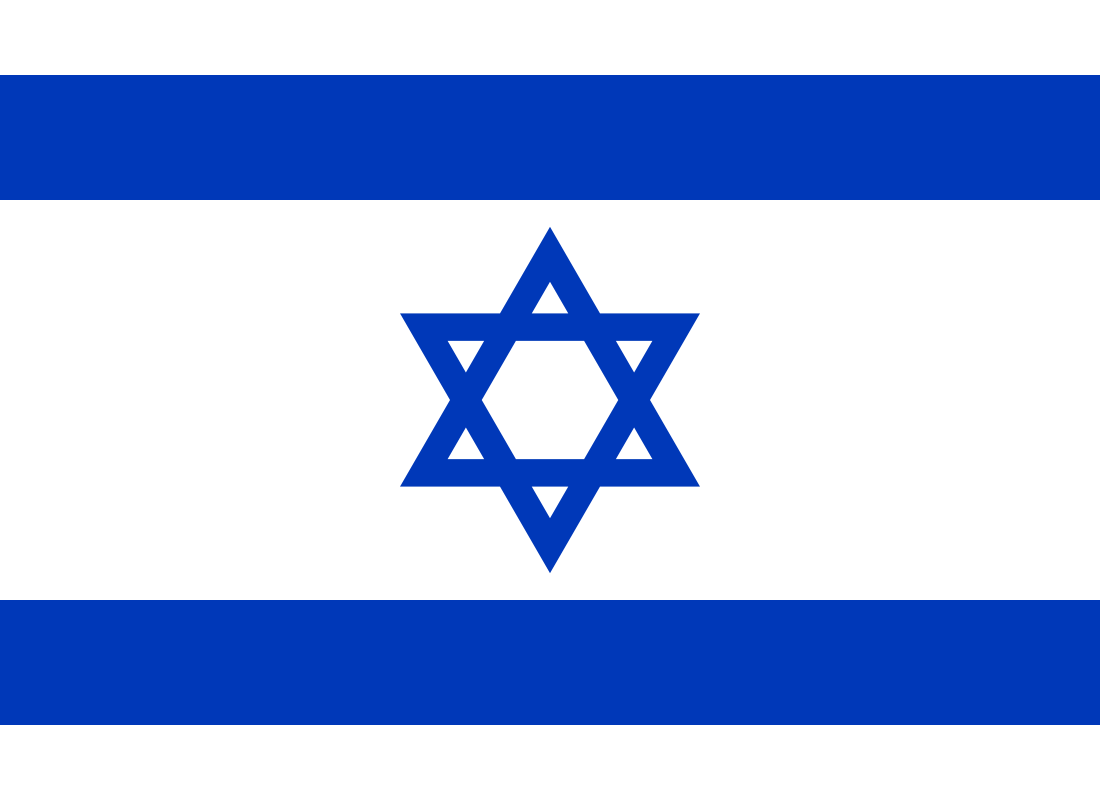
Flag image: Flag of Israel.svg, Public domain, Israel Belkind and Fanny Abramovitch (original) “The Provisional Council of State Proclamation of the Flag of the State of Israel” of 25 Tishrei 5709 (28 October 1948) provides the official specification for the design of the Israeli flag. The color of the Magen David and the stripes of the Israeli , via Wikimedia Commons.